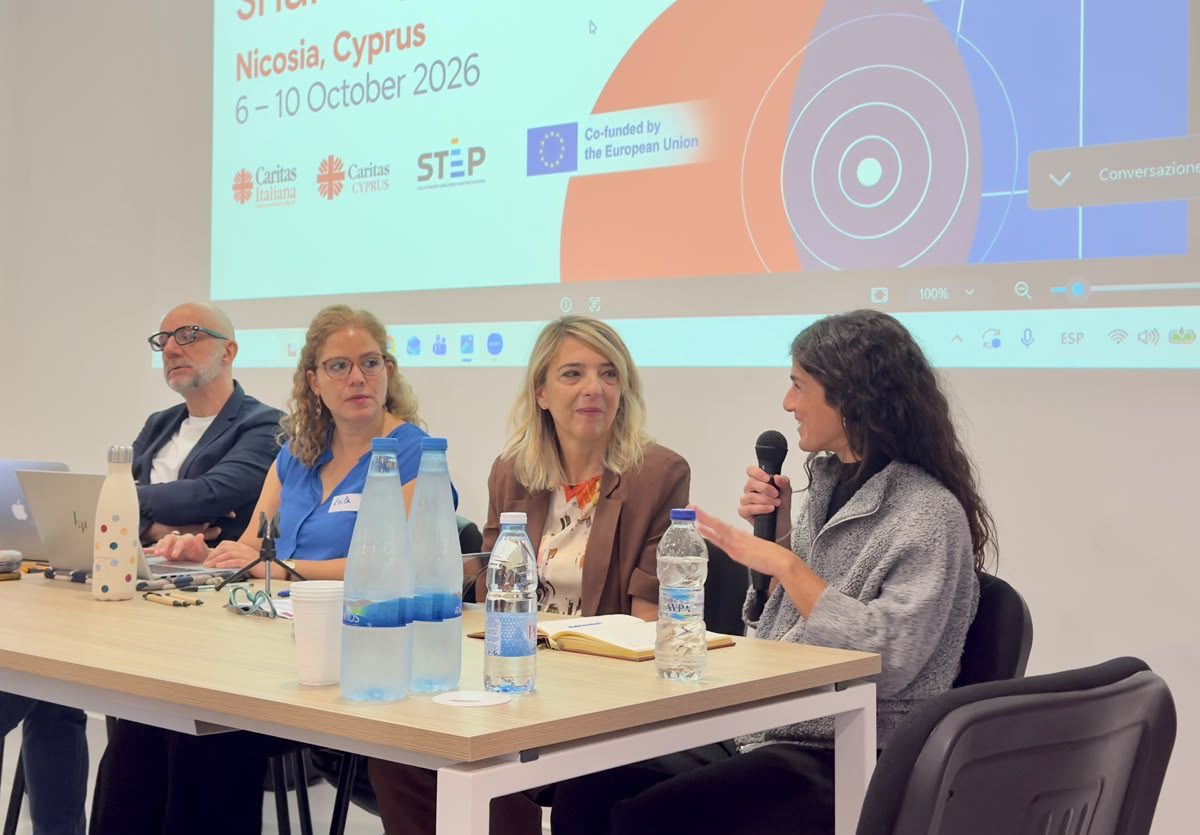
Organised by Caritas Cyprus, between October 6-9, 2026, in Nicosia, the MigraMed conference panel “The European Pact and its State of Implementation” examined the ongoing implementation of the EU Pact on Migration and Asylum and the broader priorities needed to develop a comprehensive, forward-looking European migration policy.
Leila Bodeux of Caritas Europa presented an overview of the Pact’s main components and the common framework it establishes for European migration and asylum policy. Oliviero Forti of Caritas Italiana offered an overview of the Pact’s implementation from the Italian perspective, highlighting the national dimension of translating the new framework into practice.
Contributing on behalf of MedMA, Kyriaki Chatzipanagiotou, Policy Officer in Cyprus, focused on what Europe’s migration policy needs to deliver beyond the Pact itself. She highlighted three areas that can help make migration governance more effective, sustainable and rights-based.
First, Europe needs safe, regular and accessible pathways through which people fleeing persecution, conflict and other forms of harm can reach protection. Developing these pathways would help ensure that people can seek safety through predictable, rights-based routes, while strengthening access to international protection across the region.
Second, legal labour mobility needs to become a practical and effective policy tool. Well-designed pathways should respond to genuine labour market needs, offer transparent and accessible recruitment procedures, and protect workers against exploitation. Cooperation between countries of destination and origin can also support skills development, circular mobility and knowledge exchange, helping ensure that labour mobility generates benefits for workers, employers and communities on both sides of the Mediterranean.
Third, partnerships with countries of origin and transit should be strategic, balanced and mutually beneficial. Cooperation can deliver more sustainable results when it connects migration management with shared priorities, economic opportunities, institutional capacity-building and the protection of fundamental rights. Long-term partnerships should be supported by meaningful dialogue, coordinated regional approaches and an assessment of long-term outcomes that considers not only migration management but also development, rights protection and mutual gains.
The central message by MedMA was that the Pact provides an important common foundation, while its long-term success will also depend on how it connects with these wider policy areas. By investing in protection, workable legal migration pathways and genuine partnerships, Europe can build a migration policy that is more coherent, resilient and responsive to the realities on the ground.
MedMA thanks Caritas Cyprus for organising the discussion and the fellow panellists for their valuable contributions.
![[Summary] Future of Protection Forum](https://med-ma.eu/wp-content/uploads/2026/07/073-400x250.jpg)
![[CY] MedMA to Host High-Level Forum on the Future of Refugee and Migration Protection](https://med-ma.eu/wp-content/uploads/2026/06/12-400x250.png)