
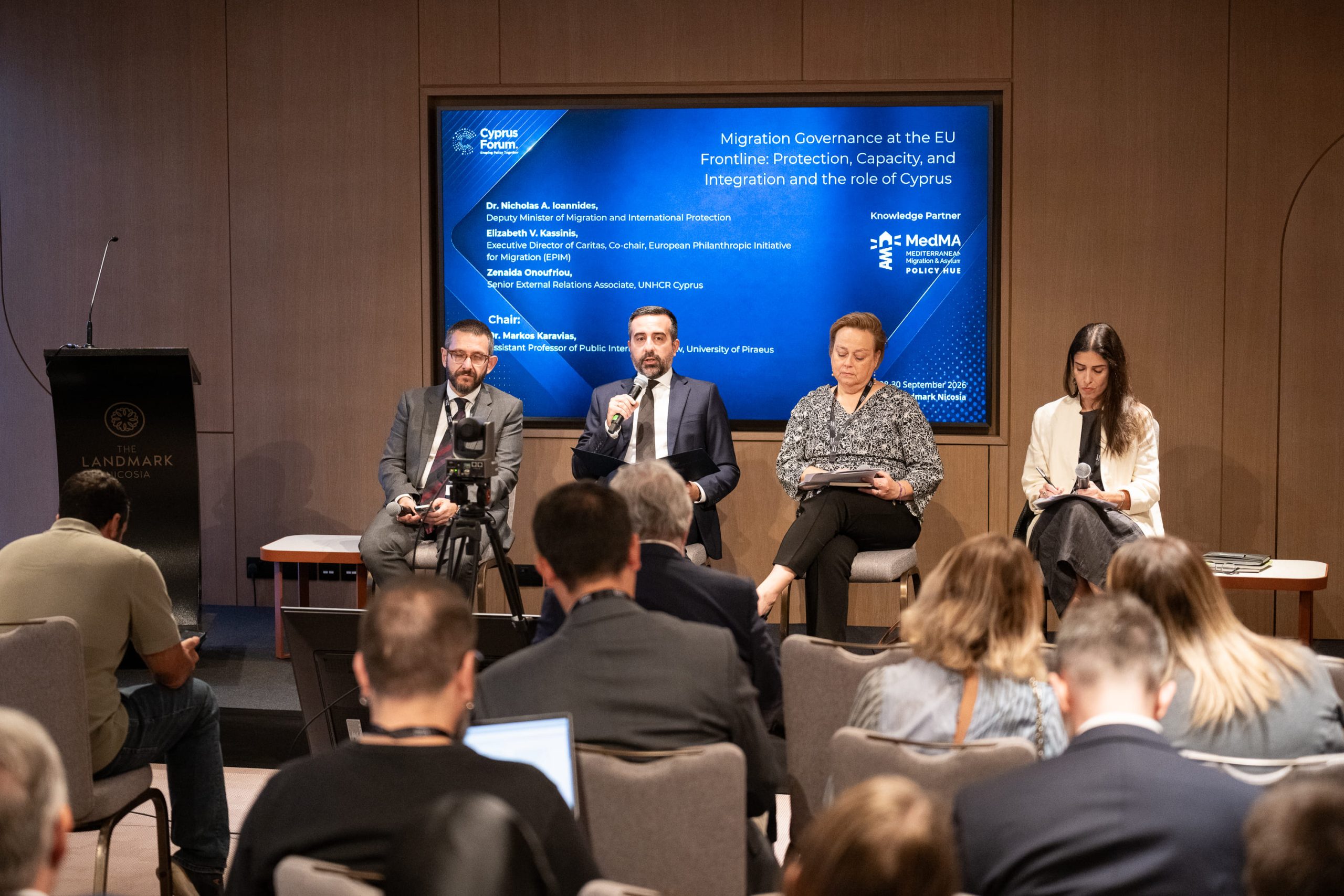
As a knowledge partner of the Cyprus Forum 2026, MedMA hosted the panel discussion “Migration Governance at the EU Frontline: Protection, Capacity, Integration, and the Role of Cyprus”, bringing together representatives of government, civil society and international organisations to discuss the challenges and priorities shaping migration governance in Cyprus.
The discussion was chaired by Dr. Markos Karavias, Assistant Professor of Public International Law at the University of Piraeus and Director of MedMA. The panel brought together Dr. Nicholas A. Ioannides, Deputy Minister of Migration and International Protection; Ms. Elizabeth V. Kassinis, Executive Director of Caritas Cyprus and Co-Chair of the European Philanthropic Initiative for Migration (EPIM); and Ms. Zinaida Onoufriou, Senior External Relations Associate at UNHCR Cyprus.
As a knowledge partner of Cyprus Forum 2026, MedMA hosted a panel discussion on “Migration Governance at the EU Frontline: Protection, Capacity, Integration, and the Role of Cyprus.” The discussion explored how Cyprus can navigate the challenges of implementing the EU Pact on Migration and Asylum while upholding fundamental rights, strengthening European solidarity, and supporting the meaningful integration of migrants.
Chaired by Dr Markos Karavias, Assistant Professor of Public International Law at the University of Piraeus and MedMA Director, the panel brought together Dr Nicholas A. Ioannides, Deputy Minister of Migration and International Protection; Elizabeth V. Kassinis, Executive Director of Caritas Cyprus and Co-Chair of EPIM; and Zinaida Onoufriou, Senior External Relations Associate at UNHCR Cyprus.
Minister Ioannides emphasised that the Pact’s effectiveness must be assessed through its practical implementation and the support it delivers to frontline Member States. Cyprus has opted for relocations under the EU solidarity mechanism, completed six relocation missions, and signed a bilateral relocation agreement with Lithuania. He stressed that solidarity must go hand in hand with responsibility, taking into account both human rights obligations and the maintaining national interests. The discussion highlighted the importance of ensuring that European commitments translate into tangible and sustained support.
The panellists underlined that effective migration governance must not come at the expense of fundamental rights. Ms. Elizabeth Kassinis cautioned against allowing a sense of crisis to undermine due process or normalise exceptions to established safeguards. She stressed the need for adequately resourced services, trained personnel and fair procedures that protect people’s safety, dignity and wellbeing, particularly those in vulnerable situations. On returns, Ms. Zenaida Onoufriou highlighted the importance of distinguishing between people who need international protection and those who do not qualify for it. While returns should be safe and dignified, asylum procedures must remain fair and effective. Regarding proposals for return hubs, she emphasised the need for strict safeguards, respect for the principle of non-refoulement, adequate living conditions, independent monitoring and specific protections for children. Any such arrangements, she noted, should be limited, temporary and consistent with international law.
The discussion also addressed the role of legal labour migration in responding to workforce needs and offering alternatives to irregular migration. Minister Ioannides outlined Cyprus’ efforts to develop labour mobility agreements, including with Egypt and India, and stressed that recruitment should respond to genuine labour market needs while protecting workers from exploitation. He also highlighted Cyprus’ first national integration strategy, approved in February 2026, which prioritises language learning, vocational training and greater familiarity with Cypriot society.
Kassinis welcomed the strategy and emphasised that its success will depend on addressing the practical barriers migrants face in everyday life. These include the cost of public transport, limited access to affordable sports and educational facilities, and the lack of childcare and support networks that can often prevent migrant women from participating. She also called for closer cooperation with civil society and grassroots organisations to identify what works, prioritise essential services, and address barriers within institutions themselves. Dedicated focal points across relevant government services, she argued, could help make implementation more coordinated and accessible.
Reflecting on the 75th anniversary of the 1951 Refugee Convention, Onoufriou reaffirmed its continuing relevance as the foundation of international refugee protection. She stressed that asylum systems must be strengthened so they can make fair and timely decisions, rather than weakened in response to mounting pressures. She also highlighted the importance of responsibility-sharing, noting that many refugees are hosted by countries with limited resources outside the EU. Alongside effective asylum systems, safe and regular migration pathways – including labour mobility – can help preserve access to protection for those who need it and reduce reliance on dangerous journeys and smuggling networks.
Overall, the discussion underscored that migration governance depends on practical solidarity between Member States, rights-compliant procedures, accessible legal pathways, adequately supported services and sustained investment in integration.
MedMA thanks Cyprus Forum for the opportunity to contribute to this important discussion, as well as the panellists for sharing their expertise and perspectives.
Watch the full discussion here [1:01 – 1:37].
![[Summary] Future of Protection Forum](https://med-ma.eu/wp-content/uploads/2026/07/073-400x250.jpg)
![[CY] MedMA to Host High-Level Forum on the Future of Refugee and Migration Protection](https://med-ma.eu/wp-content/uploads/2026/06/12-400x250.png)
![[CY] Conference Summary: National Integration Strategy for Migrants 2026–29: From Theory to Practice](https://med-ma.eu/wp-content/uploads/2026/05/compressed_under_2mb-400x250.jpg)